In industries where painting and surface finishing are part of daily production, achieving a smooth, clean, and consistent finish is essential. A spray booth provides a controlled environment for paint application while helping manage overspray, fumes, dust, and airborne contaminants. From automotive components and machinery to metal furniture and industrial equipment, spray booths are widely used to improve painting quality and workplace conditions.
This guide explains what is a spray booth, how it works, the major types of spray booths, their configurations, applications, and the factors businesses should consider when selecting a suitable spray paint booth.
What Is a Spray Booth?
A spray booth is an enclosed or semi-enclosed working area specifically designed for spray painting and coating operations. It generally includes an air-handling and filtration system that controls the movement of air through the painting area.
The main purpose of a spray booth is to create a controlled painting environment. During spray application, some paint does not reach the workpiece and becomes overspray. The booth captures and manages this overspray through suitable airflow and filtration arrangements.
Depending on the application, a booth can be designed with different airflow patterns, filtration systems, lighting arrangements, exhaust systems, and dimensions. This allows manufacturers to select a configuration according to their production requirements.
Also Read: What Is an Electrostatic Powder Coating Plant? Working, Components, Benefits & Applications
How Does a Spray Paint Booth Work?
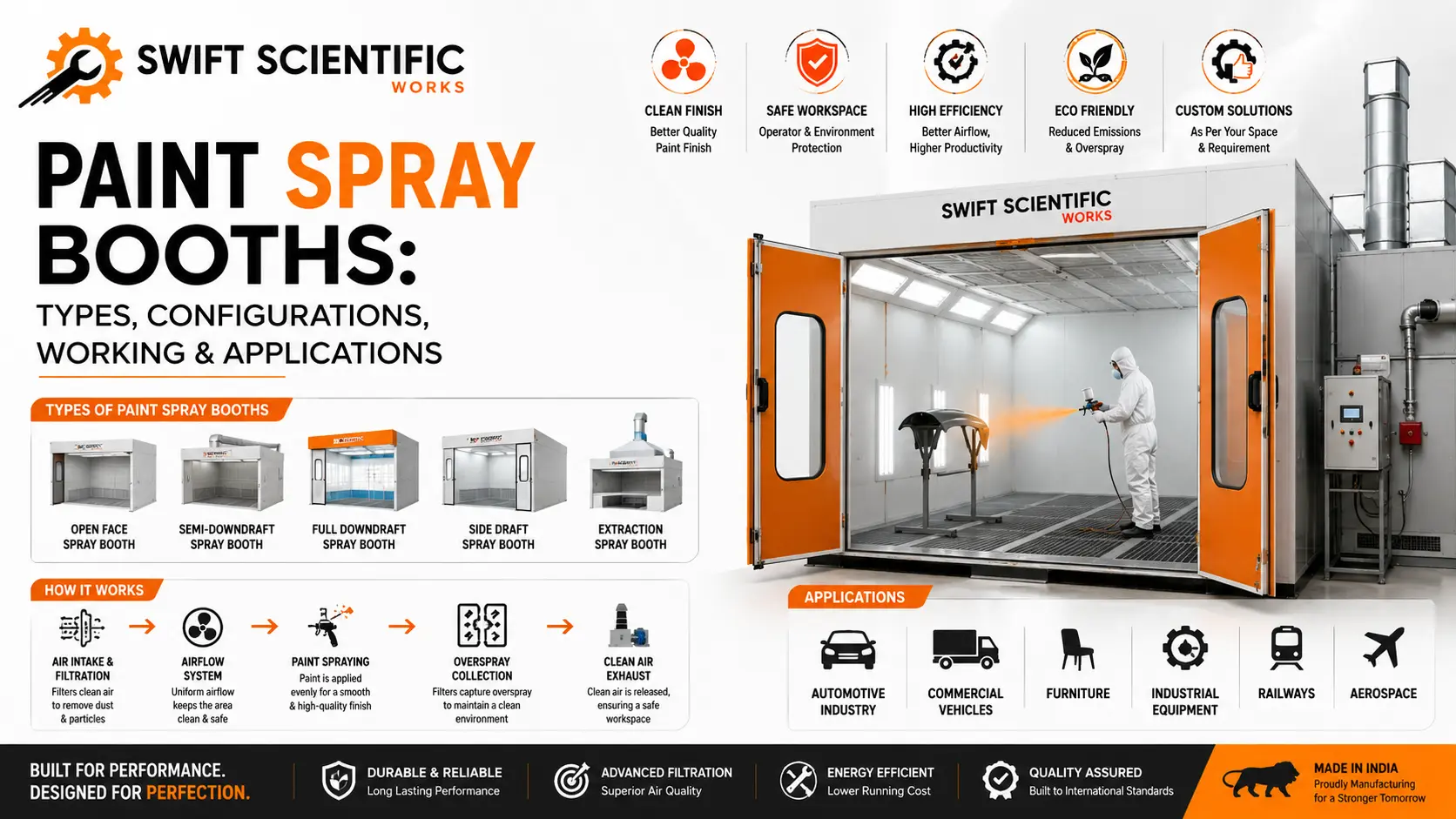
The working principle of a spray paint booth is based on controlled airflow. Fresh air enters the booth through an intake arrangement, passes through the painting area, and carries overspray and airborne contaminants toward the exhaust or filtration system.
The exact airflow pattern depends on the booth design. In some configurations, air travels horizontally across the workpiece, while in others it moves vertically from the ceiling toward the floor.
The filtration system captures paint particles before the exhausted air leaves the booth. Proper airflow helps reduce overspray accumulation around the painted component and provides a cleaner environment for painting.
A typical spray booth operation involves placing the component inside the booth, preparing the painting equipment, starting the ventilation system, applying the coating, and allowing sufficient airflow for overspray removal and drying or curing, depending on the coating process.
Types of Spray Booths
There are several types of spray booths, and each is suitable for different production requirements. The right selection depends on component size, paint type, production volume, required finish, available space, and environmental requirements.
1. Crossdraft Paint Booth
A crossdraft booth moves air horizontally across the work area. Fresh air generally enters from one side and travels toward the opposite exhaust side.
This configuration is relatively simple and can be suitable for various general-purpose industrial painting applications. It is commonly considered when a straightforward airflow arrangement is required.
2. Downdraft Paint Booth
A downdraft paint booth uses vertical airflow. Air enters from the upper section of the booth and moves downward over the workpiece before being exhausted through the lower section.
Because overspray is directed away from the painted surface, downdraft configurations can provide excellent control of airborne contaminants and help achieve high-quality finishes. These booths are particularly useful where finish quality and contamination control are important.
3. Side Draft Paint Booth
In a side draft booth, air moves horizontally or diagonally toward exhaust points located along the side or rear portion of the booth. This arrangement can provide effective overspray removal while offering flexibility in booth design.
Side draft configurations are often considered for industrial components where a full downdraft floor arrangement is not practical.
4. Open Front Paint Booth
An open front paint booth has an enclosed structure on most sides with an open working face. Air and overspray are pulled toward the rear filtration and exhaust arrangement.
This type of booth can be useful for painting large components or parts that need to be loaded and unloaded easily. It can also be designed according to the available production area and component dimensions.
5. Enclosed Paint Spray Booth
An enclosed paint spray booth provides a more controlled painting environment by enclosing the work area. It can be equipped with appropriate intake filters, exhaust filters, lighting, ventilation, and other accessories.
Enclosed configurations are useful when manufacturers require better control over dust, overspray, and the surrounding production environment.
6. Conveyorised Paint Booth
Conveyorised spray booths are integrated with conveyor systems for continuous or semi-continuous production. Components move through the painting area on a conveyor, reducing manual handling and improving production consistency.
These booths can be suitable for industries with higher production volumes and repetitive painting requirements.
Common Paint Booth Configurations
The configuration of a paint booth depends on the production process and available factory space. Important considerations include airflow direction, booth dimensions, filtration arrangement, exhaust system, lighting, access doors, and component loading method.
For smaller components, a compact booth may be sufficient. Large machinery and fabricated structures may require a larger walk-in or open-front configuration. For high-volume production, a conveyorised arrangement can provide a more streamlined workflow.
Airflow is another major consideration. Crossdraft, side draft, and downdraft arrangements each provide different methods of controlling overspray and contaminants. The appropriate configuration should be selected after evaluating the coating material, component geometry, production rate, and desired finish quality.
Key Components of Spray Booths
A professionally designed spray booth generally consists of several important components that work together to provide controlled painting conditions.
- Booth enclosure: Forms the controlled painting area and provides structural support.
- Air intake system: Allows filtered fresh air to enter the booth.
- Exhaust system: Removes contaminated air, fumes, and overspray from the painting area.
- Filtration system: Captures paint particles and helps prevent excessive overspray from entering the exhaust path.
- Lighting system: Provides sufficient illumination so operators can clearly see the surface during painting.
- Ventilation system: Maintains the required airflow through the booth.
The exact components and specifications can vary according to the coating process and booth design.
Applications of Paint Spray Booths
Industrial spray booths are used across many manufacturing sectors. Common applications include painting automobile components, agricultural machinery, industrial machinery, fabricated steel structures, metal furniture, electrical equipment, sheet-metal products, construction equipment, and various engineering components.
A spray paint booth can be particularly valuable when manufacturers need consistent coating quality and better control over overspray during production.
Industries handling different paints and coatings can also select booth configurations according to their process requirements. The booth should always be designed and operated according to applicable safety, ventilation, fire-protection, and environmental requirements.
Benefits of Using Spray Booths
Using properly designed spray booths can provide several production benefits. Controlled airflow helps manage overspray and airborne contaminants, while filtration supports a cleaner working environment.
A dedicated painting booth can also improve coating consistency by providing a defined area for paint application. Proper lighting helps operators identify surface imperfections and maintain uniform coverage.
For manufacturing companies, an appropriately configured booth can also improve workflow, reduce contamination-related finishing problems, and support more organized production processes.
How to Choose the Right Spray Booth?
Selecting the right spray booth requires more than simply choosing a booth based on its size. Manufacturers should consider the dimensions and weight of the components, coating material, painting method, production capacity, required finish quality, factory layout, airflow requirements, filtration, and exhaust arrangement.
The expected production volume is also important. A manually operated booth may be suitable for lower production requirements, while a conveyorised system may be more appropriate for repetitive, high-volume operations.
It is also important to work with an experienced manufacturer that can design the booth according to the specific application instead of relying only on standard dimensions.
Why Choose Swift Scientific Works?
Swift Scientific Works provides industrial painting and coating solutions designed around the practical requirements of manufacturing facilities. A paint booth should not only provide a space for painting but should also offer appropriate airflow, filtration, ventilation, accessibility, and operational efficiency.
By understanding the component size, coating process, production requirements, and available factory space, Swift Scientific Works can help industries select a suitable booth configuration for their application.
Frequently Asked Questions
What is a spray booth used for?
A spray booth is used to provide a controlled environment for spray painting and coating operations. It helps manage overspray, fumes, dust, and airborne contaminants while supporting consistent painting conditions.
Which is better: a downdraft paint booth or crossdraft booth?
The choice depends on the application. A downdraft paint booth provides vertical airflow and can be advantageous where high finish quality and contamination control are important. Crossdraft booths may be suitable for general industrial painting applications and simpler installations.
What are the main types of spray booths?
Common types include crossdraft, downdraft, side draft, open front, enclosed, and conveyorised spray booths. The appropriate type depends on production requirements and the painting process.
Can spray booths be customized?
Yes. Industrial spray booths can be designed according to component dimensions, airflow requirements, filtration needs, factory layout, loading method, and production volume.
Conclusion
Paint spray booths play an important role in modern industrial painting by creating a controlled environment for coating operations. From simple open-front designs to advanced downdraft paint booth and conveyorised configurations, different types of spray booths are available for different production needs.
Understanding what is a spray booth, how airflow works, and which configuration is appropriate can help manufacturers make a better investment. Whether the requirement is for general industrial painting, high-quality finishing, or continuous production, selecting the right spray paint booth can improve coating consistency, overspray management, and overall workflow.
For industries looking for a reliable industrial painting solution, Swift Scientific Works can help determine a suitable booth configuration based on the specific application and production requirements.