Industrial coating plays an important role in protecting metal components, improving their appearance, and extending their service life. From automotive parts and electrical panels to machinery, furniture, and engineering components, manufacturers use different coating techniques depending on the material, application, durability requirements, and production volume.
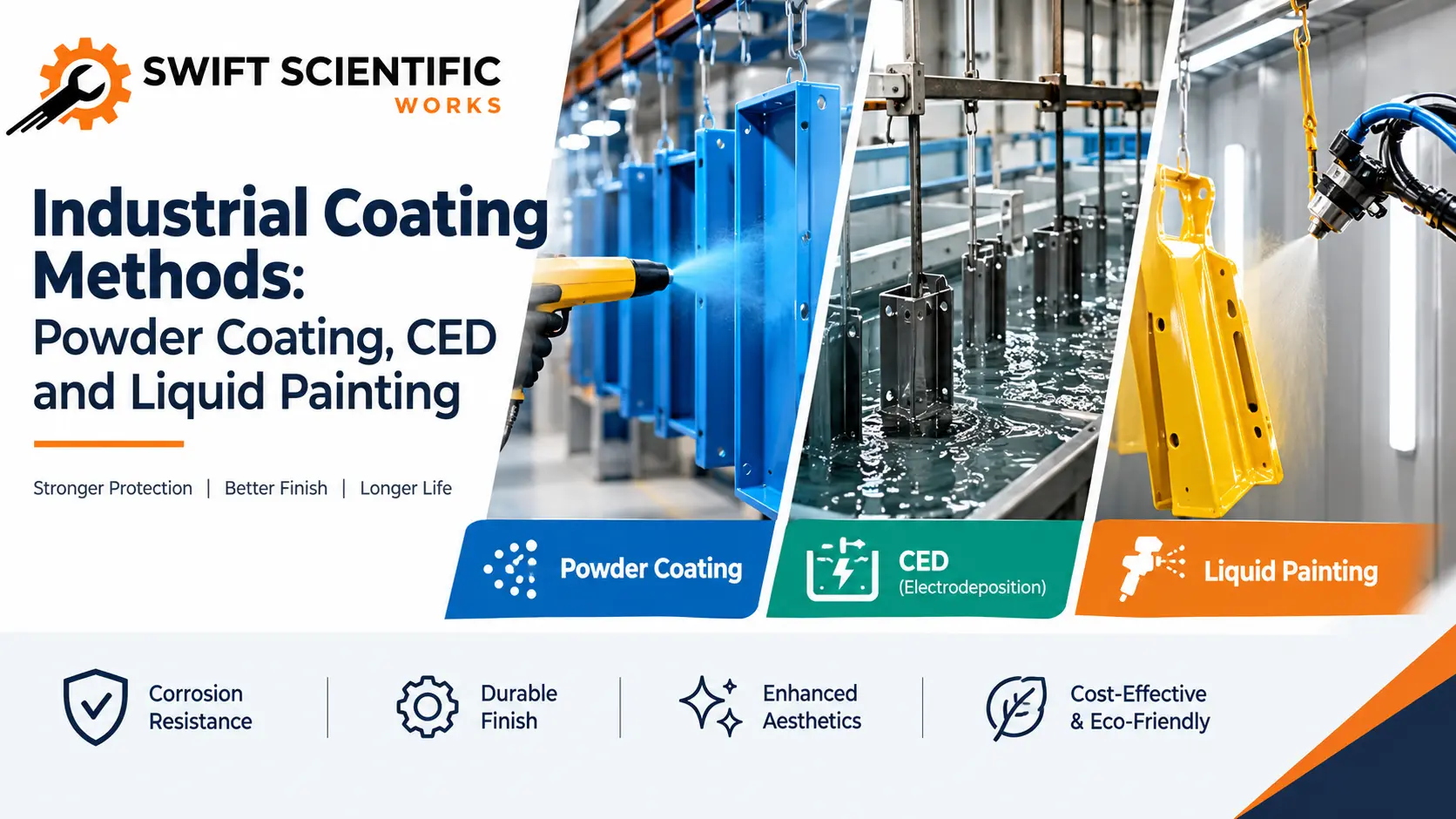
Among the most widely used industrial coating methods are powder coating, CED coating, and liquid painting. Each process has its own working principle, equipment requirements, advantages, and suitable applications. Understanding these methods can help industries select the right coating solution for their production needs.
What Are Industrial Coatings?
Industrial coatings are protective or decorative layers applied to a surface to improve its resistance against corrosion, chemicals, moisture, abrasion, heat, and environmental conditions. The coating can also provide a smooth and attractive finish to the finished product.
The selection of a coating depends on several factors, including the type of substrate, required finish, operating environment, production speed, and desired coating thickness.
Modern manufacturing facilities use different methods of coating to achieve consistent quality. Powder coating, CED, and liquid painting are three important processes commonly used across different industries.
1. Powder Coating
Powder coating is a dry finishing process in which finely ground powder is applied to a metal surface using an electrostatic spray system. The charged powder particles adhere to the grounded workpiece and are then cured inside an industrial oven.
During curing, the powder melts and forms a continuous, durable coating on the surface.
How Does Powder Coating Work?
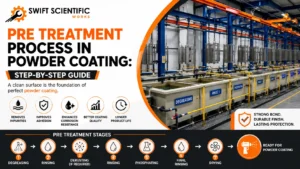
A typical powder coating process involves several stages:
- Surface cleaning and pretreatment
- Drying of the components
- Electrostatic powder application
- Transfer of coated components to the curing oven
- Heating and curing
- Cooling and inspection
Proper pretreatment is especially important because it removes oil, dirt, rust, and other contaminants that can affect coating adhesion.
Advantages of Powder Coating
Powder coating is widely used because it offers:
- Good resistance to corrosion and impact
- Durable and attractive surface finishes
- Consistent coating thickness
- Minimal liquid waste
- A wide range of colours and textures
- Suitable finishes for high-volume production
- Efficient material utilization
Powder coating is commonly used for electrical enclosures, automotive components, metal furniture, appliances, machinery parts, agricultural equipment, and general engineering products.
2. CED Coating
CED stands for Cathodic Electro Deposition. It is an electrocoating process in which electrically charged paint particles are deposited onto a conductive metal component.
The components are immersed in a specially prepared coating bath. An electrical current causes the coating material to deposit uniformly over the surface, including areas that may be difficult to cover using conventional spray techniques.
CED is particularly useful where corrosion protection and uniform coverage are important.
How Does the CED Process Work?
The basic CED process generally includes:
- Cleaning and pretreatment
- Phosphating or conversion coating
- Immersion into the CED bath
- Application of electrical current
- Rinsing and recovery
- Curing in an oven
- Final inspection
One of the major benefits of CED is its ability to provide relatively uniform coverage on complex components. It can also provide good protection in recessed areas and around edges.
Applications of CED Coating
CED is commonly used for products that require strong corrosion protection, including:
- Automotive components
- Automobile bodies and chassis parts
- Agricultural equipment
- Industrial machinery
- Electrical and engineering components
- Metal assemblies
CED is an important technology in the coating industry, especially where long-term corrosion resistance and consistent surface coverage are major requirements.
3. Liquid Painting
Liquid painting is a conventional finishing process in which liquid paint is applied to a surface using spray guns, pumps, or other application equipment. Depending on the product and required finish, different types of liquid paints can be used.
Unlike powder coating, liquid painting does not require the paint to be applied in powder form and cured through a powder coating oven. Instead, the liquid coating is generally dried or cured using air drying, controlled heating, or a combination of both.
How Does Liquid Painting Work?
A typical liquid painting process includes:
- Surface preparation
- Primer application, where required
- Liquid paint application
- Flash-off or drying
- Curing
- Final quality inspection
The process can be adapted for different component sizes and shapes. It is also suitable for applications where specific colours, finishes, or coating properties are required.
Benefits of Liquid Painting
Liquid painting offers several practical benefits:
- Wide choice of colours and finishes
- Suitable for large and complex components
- Flexible coating thickness
- Easy colour changes for certain production environments
- Suitable for heat-sensitive substrates when appropriate coatings are selected
- Can provide smooth decorative finishes
Liquid painting is used in machinery, industrial equipment, structural components, automotive parts, construction equipment, and many other applications.
Powder Coating vs CED vs Liquid Painting
Although all three processes are designed to protect and finish surfaces, their working principles are different.
| Feature | Powder Coating | CED Coating | Liquid Painting |
|---|---|---|---|
| Coating form | Dry powder | Liquid electrocoat | Liquid paint |
| Application | Electrostatic spray | Immersion with electrical current | Spray or other application |
| Curing | Usually oven curing | Oven curing | Air or oven curing |
| Main strength | Durable finish | Uniform corrosion protection | Flexible finishing |
| Suitable for | Metal components | Complex metal parts | Large and varied components |
| Colour options | Wide | More process-specific | Very wide |
The right choice depends on the product, production requirements, operating environment, and desired finish.
How to Select the Right Industrial Coating Method
There is no single coating process that works best for every application. Manufacturers should consider several factors before selecting one of the available methods of coating.
First, evaluate the substrate. Most industrial coating systems are designed around specific materials, particularly metals. Next, consider the environmental conditions in which the component will operate. Outdoor equipment may require stronger corrosion and weather resistance than indoor products.
Production volume is another important consideration. Automated powder coating or CED systems can be useful for high-volume manufacturing, while liquid painting can offer flexibility when products vary significantly in size, colour, or specification.
The required appearance also matters. If a manufacturer needs a specific decorative finish, texture, or colour, the available coating technology should be evaluated accordingly.
Importance of Surface Preparation
Regardless of the selected coating process, surface preparation has a direct impact on coating performance. Oil, grease, dust, rust, moisture, and other contaminants can reduce adhesion and lead to premature coating failure.
Depending on the material and process, surface preparation may include degreasing, cleaning, phosphating, rinsing, drying, or other pretreatment stages.
A properly prepared surface helps the coating adhere effectively and improves the overall quality and durability of the finished product.
Role of Industrial Coating Equipment
Modern coating systems use specialized equipment to maintain consistent production quality. Powder coating plants may include pretreatment systems, powder booths, recovery systems, curing ovens, and conveyors. CED systems require coating tanks, rectifiers, filtration and rinsing arrangements, and curing ovens.
Liquid painting facilities may use spray booths, paint application equipment, ventilation systems, drying areas, and curing equipment.
The design of the complete system should match the component size, production capacity, coating specification, and available factory space.
Conclusion
Powder coating, CED coating, and liquid painting are important industrial coating methods, each serving different manufacturing requirements. Powder coating is widely used for durable finishes and efficient production, CED provides uniform electro-deposited protection for suitable metal components, while liquid painting offers flexibility in colours, finishes, and component sizes.
For manufacturers, choosing the right process means looking beyond the coating material itself. Surface preparation, equipment, production volume, curing requirements, environmental conditions, and final product expectations all need to be considered.
As the coating industry continues to adopt more efficient and controlled production technologies, properly designed coating systems can help manufacturers achieve consistent quality, improved surface protection, and longer-lasting products.