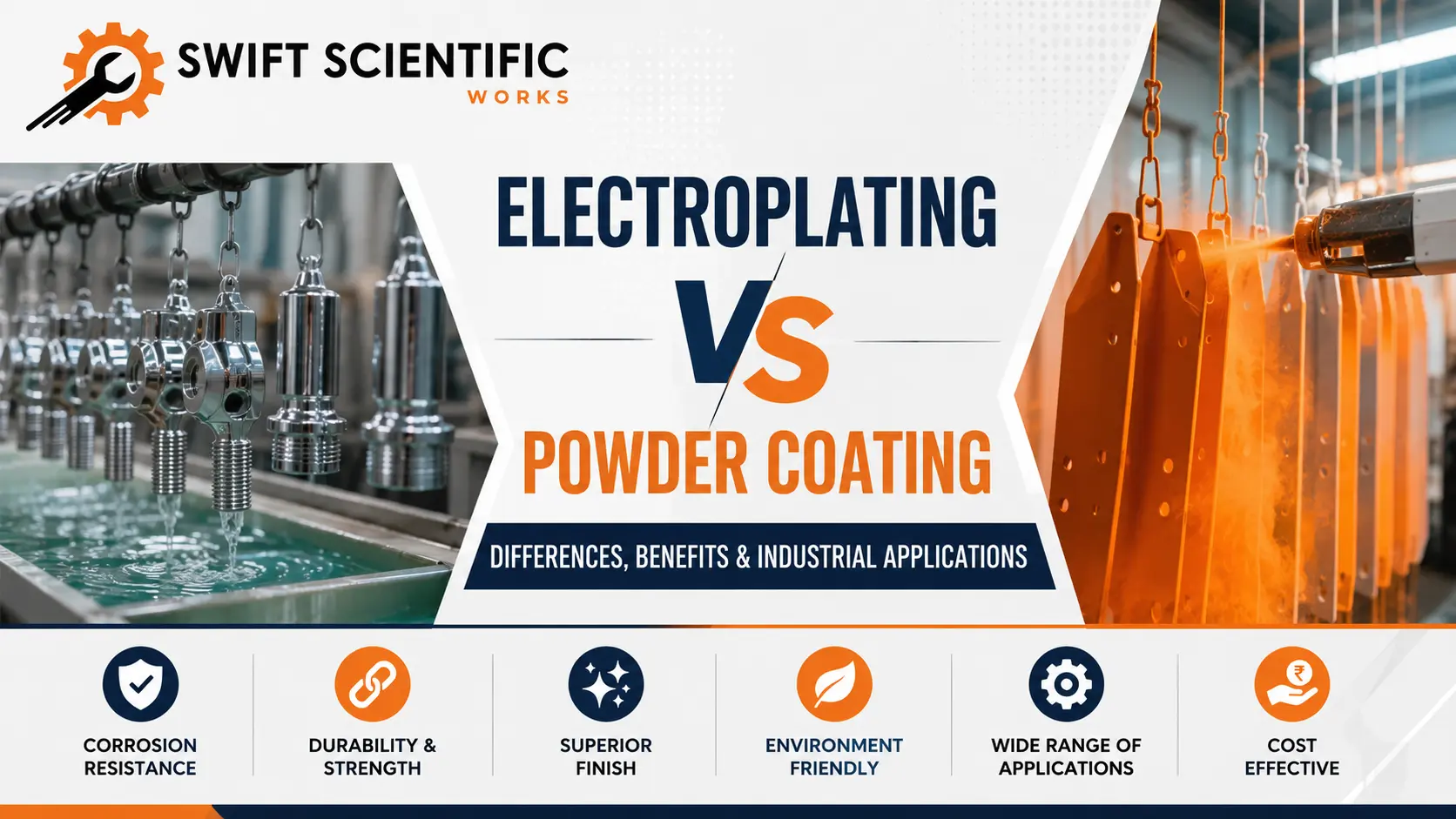
Surface finishing plays a crucial role in modern manufacturing industries. It not only improves the appearance of products but also enhances durability, corrosion resistance, and overall performance. Among the various finishing methods available today, electroplating and powder coating are two of the most widely used technologies.
Both processes provide protective coatings for metal surfaces, but they differ significantly in terms of working principles, applications, costs, environmental impact, and performance characteristics. Understanding these differences can help manufacturers choose the right finishing solution for their specific requirements. In this blog, we will explore Electroplating vs Powder Coating, their working processes, advantages, limitations, and industrial applications.
What is Electroplating?
Electroplating is a surface finishing process that uses an electric current to deposit a thin layer of metal onto the surface of another metal component. The process involves immersing the component in an electrolyte solution containing metal ions. When electricity passes through the solution, metal ions are deposited onto the surface of the workpiece, creating a protective and decorative coating.
Common electroplating metals include Nickel, Zinc, Chromium, Copper, Gold, Silver and Tin. Electroplating is commonly used when a thin metallic coating is required to improve corrosion resistance, conductivity, or appearance.
Also Read: Pre Treatment Process in Powder Coating: Step-by-Step Guide
What is Powder Coating?
Powder coating is a dry finishing process in which finely ground powder particles are electrostatically charged and sprayed onto a metal surface. The coated component is then cured in an industrial oven, where the powder melts and forms a durable protective layer.
Unlike liquid paints, powder coating does not require solvents and produces a thicker, more uniform finish. Powder coating is widely used across industries because of its durability, environmental friendliness, and attractive finish.
How Electroplating Works
The electroplating process typically involves:
- Surface Cleaning- The component is cleaned to remove dirt, grease, and contaminants.
- Surface Preparation- Rust, oxidation, and scale are removed to prepare the substrate.
- Electrolyte Bath- The component is immersed in a solution containing metal ions.
- Electrical Current- Electric current passes through the solution, causing metal ions to deposit onto the surface.
- Rinsing and Drying- The plated component is rinsed and dried before inspection.
The final result is a thin metallic coating that improves the component’s surface properties.
How Powder Coating Works
The powder coating process generally includes:
- Surface Pre-Treatment- Components are cleaned and chemically treated to improve coating adhesion.
- Powder Application- Electrostatically charged powder is sprayed onto the metal surface.
- Curing Process- The coated component is heated in a curing oven.
- Final Inspection- The finished product is inspected for coating thickness and finish quality.
The result is a durable, uniform, and attractive coating with excellent resistance to wear and corrosion.
Electroplating vs Powder Coating: Key Differences
Coating Material
- Electroplating- Uses a metallic coating deposited through electrochemical reactions.
- Powder Coating- Uses dry powder particles that are cured to form a protective layer.
Coating Thickness
- Electroplating- Produces relatively thin coatings.
- Powder Coating- Creates thicker and more durable protective layers.
Corrosion Resistance
- Electroplating- Offers good corrosion protection depending on the plating material used.
- Powder Coating- Provides excellent corrosion resistance when combined with proper pre-treatment.
Durability
- Electroplating- Suitable for moderate wear resistance requirements.
- Powder Coating- Offers superior resistance to chipping, scratching, fading, and wear.
Appearance
- Electroplating- Provides a metallic, shiny finish.
- Powder Coating- Available in numerous colors, textures, and finishes.
Environmental Impact
- Electroplating- Involves chemical solutions and wastewater treatment requirements.
- Powder Coating- Produces minimal waste and contains no harmful solvents.
Maintenance Requirements
- Electroplating- May require periodic maintenance depending on operating conditions.
- Powder Coating- Generally requires less maintenance due to its durability.
Benefits of Electroplating
Electroplating offers several advantages for specific industrial applications.
- Improved Conductivity- Electroplated coatings are commonly used in electrical and electronic components.
- Decorative Finish- Chrome, gold, and nickel plating provide attractive metallic finishes.
- Enhanced Corrosion Protection- Zinc and nickel plating help protect metal components from corrosion.
- Increased Surface Hardness- Electroplated coatings can improve wear resistance.
- Precision Applications- Electroplating is suitable for components requiring very thin and controlled coating thickness.
Benefits of Powder Coating
Powder coating has become one of the most preferred finishing solutions for industrial products.
- Superior Durability- Powder-coated surfaces. resist: Chipping, Scratching, Cracking, Peeling.
- Excellent Corrosion Resistance- Properly pre-treated and powder-coated components offer long-term protection against rust and environmental damage.
- Environmentally Friendly- Powder coating contains no solvents and generates minimal waste.
- Cost-Effective- The process offers high material utilization and lower maintenance costs.
- Wide Range of Finishes- Manufacturers can choose from:
- Matte finishes
- Gloss finishes
- Textured finishes
- Metallic finishes
- Custom colors
Industrial Applications of Electroplating
Electroplating is widely used in industries where conductivity, decorative appearance, or thin protective coatings are required.
Automotive Industry
- Decorative trims
- Fasteners
- Engine components
Electronics Industry
- Connectors
- Circuit boards
- Electrical contacts
Aerospace Industry
- Precision aircraft components
- Corrosion-resistant parts
Medical Industry
- Surgical instruments
- Medical devices
Jewelry Industry
- Gold-plated jewelry
- Silver-plated accessories
Industrial Applications of Powder Coating
Powder coating is extensively used across manufacturing sectors due to its durability and versatility.
Automotive Industry
- Wheels
- Chassis components
- Metal brackets
Furniture Industry
- Office furniture
- Outdoor furniture
- Storage systems
Electrical Industry
- Control panels
- Switchgear enclosures
- Electrical cabinets
Construction Industry
- Architectural structures
- Railings
- Fencing systems
Industrial Equipment
- Machinery components
- Material handling systems
- Fabricated metal products
Which One is Better: Electroplating or Powder Coating?
The answer depends entirely on the application requirements.
Choose Electroplating When:
- High electrical conductivity is required.
- A metallic decorative finish is needed.
- Thin and precise coatings are preferred.
- Specialized surface properties are required.
Choose Powder Coating When:
- Long-term durability is important.
- Superior corrosion resistance is needed.
- Environmental compliance is a priority.
- A wide range of colors and finishes is required.
- Heavy-duty industrial applications are involved.
For many industrial products, powder coating is often preferred because of its durability, cost-effectiveness, and environmental advantages.
Factors to Consider Before Selecting a Finishing Process
Before deciding between electroplating and powder coating, manufacturers should evaluate:
- Product application
- Operating environment
- Corrosion exposure
- Aesthetic requirements
- Production volume
- Maintenance expectations
- Environmental regulations
- Budget constraints
Careful consideration of these factors helps ensure the best finishing solution for long-term performance.
Conclusion
When comparing Electroplating vs Powder Coating, both technologies offer unique advantages and serve important roles in modern manufacturing. Electroplating provides excellent conductivity, decorative appeal, and precise metallic coatings, making it ideal for electronics, automotive components, and specialty applications.
Powder coating, on the other hand, offers outstanding durability, corrosion resistance, environmental benefits, and design flexibility. It has become the preferred finishing solution for a wide range of industrial, automotive, architectural, and engineering applications.
By understanding the differences, benefits, and industrial applications of both processes, manufacturers can make informed decisions and select the most suitable surface finishing method for their products and operational requirements.