An electrostatic powder coating plant is a complete industrial finishing system designed to apply dry powder coating onto metal components and cure it into a durable, attractive, and protective surface. Unlike conventional liquid painting, powder coating does not rely on liquid solvents. Instead, electrically charged powder particles are sprayed onto grounded metal surfaces and then heated inside a curing oven to form a strong and uniform coating.
Today, powder coating is widely used for electrical panels, automotive parts, metal furniture, industrial machinery, appliances, fabricated components, agricultural equipment, and many other products. For manufacturers handling medium- to high-volume production, installing the right powder coating plant can improve finishing quality, productivity, and material utilization.
What Is an Electrostatic Powder Coating Plant?
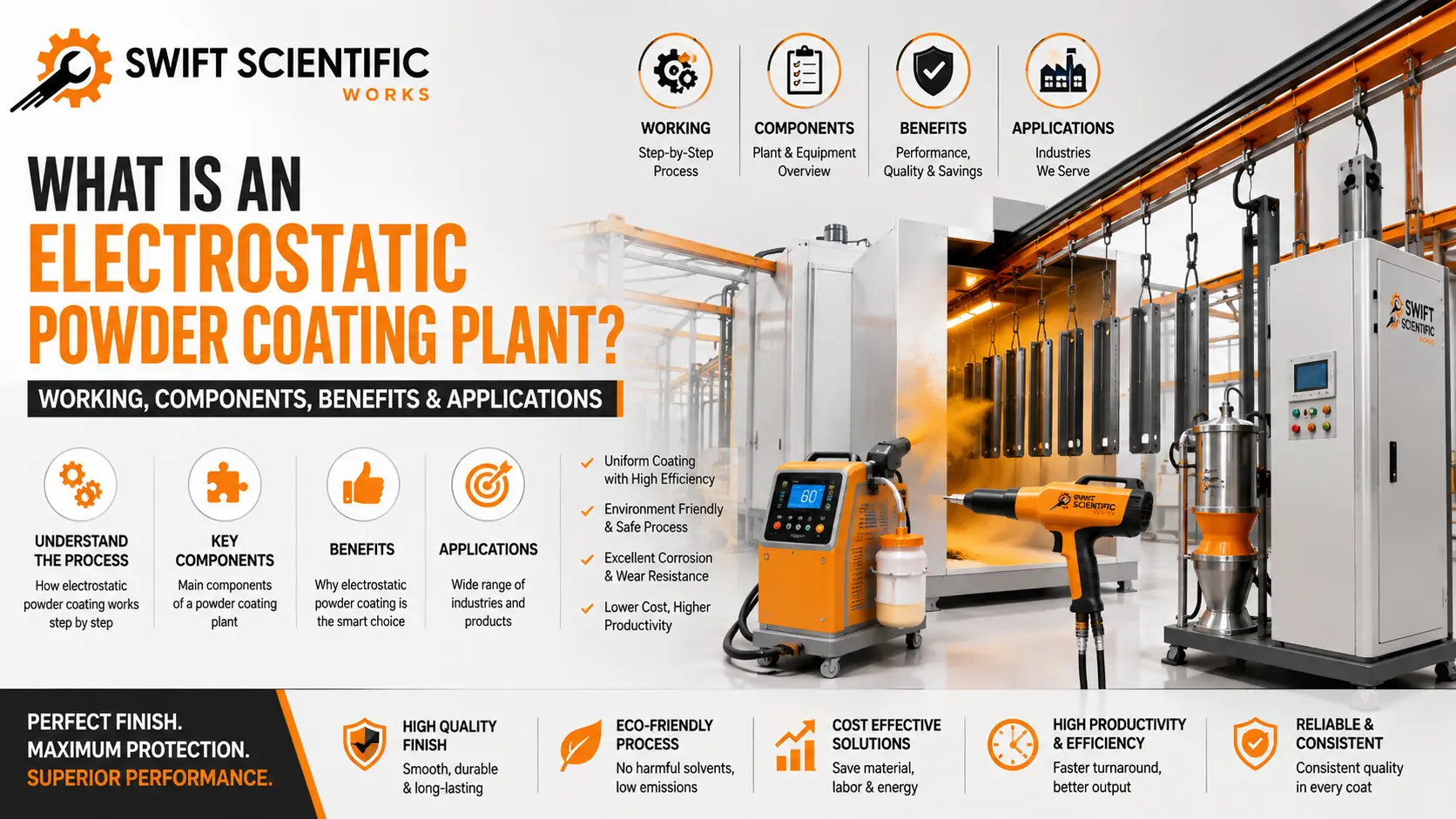
An electrostatic powder coating plant is an integrated setup that combines surface preparation, powder application, curing, material handling, and other supporting systems required for industrial powder coating.
The word electrostatic refers to the charging of powder particles during spraying. The powder coating gun gives the particles an electrical charge, while the metal component is grounded. The charged particles are attracted to the grounded surface, allowing the powder to form a coating over the component.
After application, the coated component is heated in a curing oven. The powder melts and flows over the surface before chemically curing into a hard and continuous finish. A complete plant can be configured as a manual, semi-automatic, or fully automatic system depending on production requirements.
Also Read: 7 Tank Phosphating Process for Powder Coating: A Comprehensive Guide
How Does an Electrostatic Powder Coating Plant Work?
The working process starts with preparing the metal surface. Oil, grease, dust, rust, and other contaminants must be removed before powder application. Depending on the required coating performance, a pretreatment system such as a multi-stage phosphating line may be used.
After cleaning and pretreatment, components are dried and transferred to the powder coating booth. The electrostatic spray gun charges the powder particles as they are sprayed.
Because the workpiece is electrically grounded, the charged powder is attracted to its surface. This creates a relatively uniform layer of powder over the component.
The coated component then moves into the curing oven. Controlled heat causes the powder to melt, flow, and cure. Once curing is complete, the component is cooled and inspected before being packed or sent for further assembly.
The basic sequence is:
Surface Preparation → Pretreatment → Drying → Powder Application → Curing → Cooling → Inspection
Main Components of a Powder Coating Plant
The configuration of an electrostatic powder coating plant depends on the product and production volume, but a typical industrial setup can include several major components.
Pretreatment System
Pretreatment removes contaminants and prepares the metal surface for powder coating. It may include degreasing, rinsing, phosphating, passivation, and other treatment stages.
For applications requiring better corrosion resistance and coating adhesion, proper pretreatment is particularly important.
Powder Coating Booth
The powder coating booth provides a controlled area for spraying powder onto components. It helps contain overspray and can be equipped with a powder recovery system.
The booth design depends on component dimensions, production speed, number of spray guns, and whether the system is manual or automatic.
Electrostatic Powder Coating Gun
The spray gun charges and applies powder to the workpiece. Modern guns can provide control over parameters such as voltage, current, powder output, and air flow.
The right gun configuration can help achieve consistent coating thickness and efficient powder transfer.
Powder Recovery System
During spraying, some powder does not land on the component. A recovery system collects suitable overspray and, depending on the powder and process configuration, may allow it to be reused.
An efficient recovery arrangement can help reduce material wastage and improve operating economics.
Curing Oven
The curing oven is responsible for converting the applied powder into the final coating. It maintains the required temperature for the specified curing time.
Oven design should consider component size, production capacity, heat distribution, fuel or heating method, and energy efficiency.
Conveyor System
For continuous production, conveyors transport components through different stages of the plant. Depending on the layout, the conveyor may carry parts through pretreatment, drying, coating, curing, and cooling sections.
A properly designed conveyor helps maintain consistent production flow and reduces manual handling.
Control Panel
The control system manages and monitors different plant functions. Depending on the automation level, it can control conveyor movement, oven temperature, spray parameters, pretreatment conditions, and safety functions.
Manual vs Automatic Powder Coating Plants
Manufacturers generally select between manual, semi-automatic, and automatic systems based on production requirements.
A manual powder coating plant is suitable for smaller production volumes, varied components, and applications where operators need greater control over individual parts. It generally requires a lower initial investment and offers flexibility.
A semi-automatic plant combines manual loading or unloading with automated processes such as conveyor movement, gun operation, or curing.
A fully automatic powder coating plant is designed for higher production volumes. Automated guns, reciprocators, conveyors, recovery systems, and control systems work together to improve consistency and production speed.
The right choice depends on component dimensions, daily production, product variety, available space, labor requirements, and the desired level of automation.
Benefits of an Electrostatic Powder Coating Plant
A properly designed electrostatic powder coating plant offers several benefits to manufacturers.
Durable Surface Finish
Powder coatings can provide good resistance to chipping, abrasion, impact, and general environmental exposure when the correct coating material and curing conditions are used.
Better Coating Consistency
Controlled powder application and curing can provide a more consistent finish compared with highly variable manual liquid painting processes.
Efficient Powder Utilization
Electrostatic application helps powder particles adhere to grounded metal surfaces. With a suitable recovery system, overspray can potentially be collected and reused according to the coating process requirements.
Reduced Solvent Use
Powder coating uses dry powder rather than conventional solvent-based liquid paint. This can reduce the use of certain organic solvents in the coating process.
Higher Productivity
An integrated plant can connect surface preparation, coating, curing, and material handling into a continuous production process. This is particularly valuable for manufacturers with repetitive and high-volume coating requirements.
Applications of Electrostatic Powder Coating Plants
Electrostatic powder coating plants are used across many industries and product categories.
Common applications include:
- Electrical control panels and enclosures
- Automotive and two-wheeler components
- Metal furniture
- Industrial machinery
- Agricultural equipment
- Lighting fixtures
- Appliances
- Steel fabrications
- Storage racks
- Material-handling equipment
- Architectural metal components
- General engineering products
The plant should be designed according to the size, shape, material, coating specification, and production volume of the components.
How to Choose the Right Powder Coating Plant?
Selecting an electrostatic powder coating plant should begin with understanding your actual production requirements rather than simply comparing equipment prices.
Consider the maximum component dimensions, component weight, daily production volume, required coating thickness, powder type, available factory space, and desired automation level.
You should also evaluate the pretreatment method, booth configuration, powder recovery system, curing oven capacity, conveyor speed, energy consumption, and control system.
After-sales service is another important consideration. A reliable manufacturer should be able to provide installation assistance, commissioning support, operator guidance, maintenance support, and access to essential spare parts.
Why Choose Swift Scientific Works?
For industrial coating applications, every manufacturing process has different requirements. A small workshop, an electrical panel manufacturer, and a high-volume automotive component manufacturer may all require completely different plant configurations.
Swift Scientific Works provides powder coating solutions designed around the production requirements of different industries. From powder application equipment and coating booths to complete coating plant configurations, the focus should be on achieving reliable operation, consistent finishing, efficient powder utilization, and practical production flow.
Before selecting equipment, manufacturers can discuss their component size, production volume, coating requirements, and available space to determine a suitable plant configuration.
Conclusion
An electrostatic powder coating plant is more than a powder spray machine. It is a complete finishing system that can combine pretreatment, drying, electrostatic powder application, recovery, curing, conveying, and process control.
The electrostatic principle allows charged powder particles to be attracted to grounded metal components, while the curing oven transforms the deposited powder into a durable finished coating. With the right equipment configuration and proper process control, manufacturers can achieve consistent finishes, improve productivity, and optimize powder consumption.
For businesses planning to install a new powder coating line or upgrade an existing setup, selecting equipment according to production volume, component dimensions, automation requirements, coating specifications, and future expansion plans is essential. A properly designed system can become a valuable part of a modern manufacturing operation while delivering reliable and repeatable finishing performance.