Powder coating is widely used for protecting metal components from corrosion while giving them a clean, durable and attractive finish. However, the quality of powder coating does not depend only on the powder or spray gun. Surface preparation is equally important. If oil, grease, rust, dust or other contaminants remain on the metal surface, even a high-quality powder coating may eventually peel, blister or lose adhesion.
This is where the 7 tank phosphating process becomes important. It is a systematic chemical surface-treatment process used before powder coating to clean and prepare metal components. The process improves coating adhesion, supports corrosion resistance and creates a more suitable surface for powder application.
For manufacturers handling fabricated steel parts, automotive components, electrical panels, furniture, appliances and industrial equipment, understanding the 7 tank powder coating process can help improve finishing quality and production consistency.
What Is the 7 Tank Process for Powder Coating?
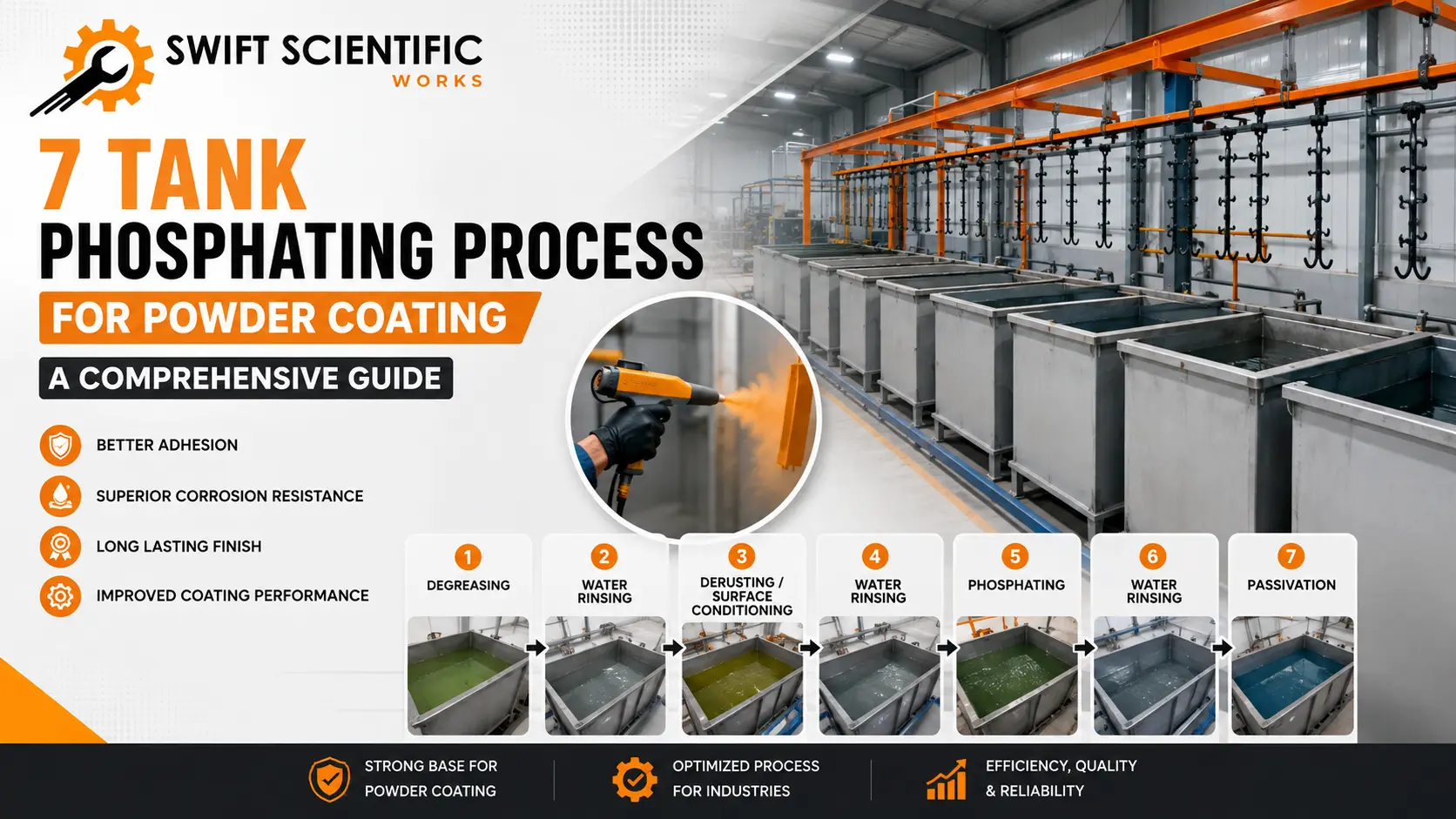
The 7 tank process for powder coating is a multi-stage pretreatment system in which metal components are passed through a series of chemical and water-treatment tanks before powder coating.
Each tank performs a specific function. Depending on the metal, chemical supplier and production requirement, the exact chemical sequence can vary. A commonly used arrangement includes cleaning, rinsing, derusting or surface conditioning, phosphating, rinsing and final passivation.
The main purpose is to remove contaminants from the metal and create a chemically treated surface that allows the powder coating to bond more effectively.
A typical sequence may be:
Degreasing → Water Rinsing → Derusting/Surface Conditioning → Water Rinsing → Phosphating → Water Rinsing → Passivation
The actual formulation, concentration, temperature and treatment time should always be selected according to the substrate and chemical manufacturer’s recommendations.
Why Is Phosphating Required Before Powder Coating?
Before powder coating, metal surfaces often contain oil, grease, dirt, rust and other contaminants left behind during manufacturing, handling or storage. Simply spraying powder over such a surface can result in poor adhesion and premature coating failure.
Phosphating creates a thin conversion coating on the metal surface. This layer provides a better foundation for the powder coating and can also improve resistance to corrosion under suitable process conditions.
The phosphating process is therefore not just a cleaning operation. It is a surface-conversion treatment that changes the characteristics of the metal surface before the final coating is applied.
Also Read: Powder Coating Machine & Gun: Price, Types, Working & Buying Guide in India
Step-by-Step 7 Tank Powder Coating Process
Tank 1: Degreasing
The first stage is generally alkaline or chemical degreasing. It removes oil, grease, machining residues and other organic contaminants from the metal component.
Effective degreasing is essential because phosphating chemicals cannot work properly on a surface covered with oil or grease.
The treatment may be carried out through immersion or spray application, depending on the pretreatment plant design.
Tank 2: Water Rinsing
After degreasing, the component enters a water-rinsing tank. This stage removes residual alkaline chemicals and loosened contaminants from the surface.
Proper rinsing prevents the chemicals from the first stage from unnecessarily contaminating the following treatment tank.
Water quality and regular monitoring are important because poor rinsing can negatively affect the subsequent pretreatment stages.
Tank 3: Derusting or Surface Conditioning
Depending on the material and condition of the components, the third stage may involve derusting, activation or surface conditioning.
For components containing rust or scale, a suitable derusting treatment can help expose a cleaner metal surface. In other systems, a conditioning or activation stage may be used to prepare the surface for uniform phosphate crystal formation.
The exact chemical used depends on the substrate, such as mild steel, galvanized steel or other metals.
Tank 4: Water Rinsing
A second water-rinsing stage removes residual chemicals from the previous treatment.
This step is particularly important before phosphating because unwanted carryover can affect the chemistry of the phosphate bath and reduce treatment consistency.
Regular tank maintenance and water replacement schedules should be established according to production volume and chemical loading.
Tank 5: Phosphating
This is the key stage of the phosphating process 7 tank process.
During phosphating, the cleaned metal surface reacts with the treatment solution and develops a thin phosphate conversion layer. This layer helps create a more suitable surface for subsequent powder coating.
The quality of the phosphate layer depends on several factors, including:
- Chemical concentration
- Bath temperature
- Treatment time
- Surface cleanliness
- pH
- Contamination level
- Type of substrate
- Process control
A properly controlled phosphate treatment can improve powder coating adhesion and contribute to corrosion protection.
Different phosphate technologies may be selected depending on the application. Iron phosphating and zinc phosphating are two commonly encountered approaches, but the appropriate process should be determined based on the required performance and substrate.
Tank 6: Water Rinsing
After phosphating, the component is rinsed again to remove loose chemicals and residues from the surface.
This stage helps prevent unwanted chemical carryover into the final treatment stage and supports a cleaner surface before drying and powder application.
Good rinsing practices are particularly important for maintaining consistent coating quality across large production batches.
Tank 7: Passivation or Final Treatment
The seventh tank can be used for passivation or another final surface treatment, depending on the selected pretreatment system.
The final treatment helps stabilize and protect the treated surface before powder coating. In modern systems, the chemistry may be selected to improve corrosion performance and provide a suitable base for the coating.
After the final treatment, components are generally drained and dried properly before entering the powder coating stage.
What Happens After the 7 Tank Process?
Once the pretreatment cycle is complete, the components must be dried thoroughly. Any remaining moisture can interfere with powder application and curing.
The dry components are then transferred to the powder coating booth. Electrostatic powder coating equipment charges the powder particles and sprays them onto the grounded metal surface.
The coated components subsequently enter a curing oven. Under controlled heat, the powder melts, flows and chemically cures to form the final coating.
Therefore, the overall process can be understood as:
Cleaning → Pretreatment → Phosphating → Rinsing → Drying → Powder Application → Curing
Every stage contributes to the final finish.
Benefits of the 7 Tank Process
A properly designed 7 tank process can offer several benefits for industrial powder coating operations.
Better Coating Adhesion
Surface preparation removes contaminants and provides a treated surface that supports better bonding between the metal and powder coating.
Improved Corrosion Protection
The pretreatment layer can provide additional protection against corrosion, particularly when the complete coating system is properly designed and maintained.
More Consistent Finish
Effective cleaning and chemical treatment help reduce coating defects associated with contamination and poor surface preparation.
Longer Coating Life
A well-prepared surface can help reduce problems such as peeling, flaking and premature coating failure.
Suitable for Industrial Production
A properly engineered pretreatment system can be integrated into manual, semi-automatic or conveyorised powder coating operations.
Factors That Affect 7 Tank Process Performance
Installing tanks alone does not guarantee good results. The chemistry and operating conditions need to be controlled continuously.
Important parameters include chemical concentration, temperature, pH, treatment time, water quality, tank cleanliness and contamination levels.
The components should also be loaded correctly so that all surfaces receive adequate treatment. Poor drainage, trapped liquid or inadequate rinsing can create coating problems later.
Regular testing of pretreatment baths and timely chemical maintenance are therefore essential parts of an effective system.
7 Tank Process vs Basic Surface Cleaning
Basic cleaning may remove visible oil and dirt, but it may not provide the same level of surface conditioning required for demanding industrial powder coating applications.
The 7 tank powder coating process provides multiple controlled stages, allowing manufacturers to clean, condition, phosphate, rinse and finalize the metal surface before powder application.
For products exposed to moisture, outdoor conditions, chemicals or mechanical wear, proper pretreatment can be particularly important.
Applications of the 7 Tank Phosphating Process
The process can be used for a wide range of metal products, including:
- Electrical control panels
- Metal furniture
- Automotive components
- Industrial machinery parts
- Agricultural equipment
- Fabricated steel components
- Storage and material-handling equipment
- Appliances
- Metal enclosures
- General engineering components
The exact pretreatment chemistry should be selected according to the metal substrate, required coating performance and operating environment.
Conclusion
The 7 tank phosphating process for powder coating is an important surface-preparation method for achieving reliable and durable finishes on metal components. From degreasing and rinsing to phosphating and final treatment, every stage has a specific purpose.
A well-controlled 7 tank process can improve surface cleanliness, powder coating adhesion, corrosion resistance and overall finishing consistency. However, the exact seven-stage sequence can vary according to the substrate, chemical system and production requirements.
For manufacturers planning a new powder coating line or upgrading an existing setup, selecting the right pretreatment arrangement is just as important as choosing the powder coating booth, spray equipment and curing oven. Swift Scientific Works can help businesses evaluate their coating requirements and develop suitable surface-treatment and powder coating solutions for their production needs.